
Kobe Steel, Ltd.
大阪・関西万博で描く “ものづくり”の未来像。 二人三脚で挑んだ創造の旅
- Corporation
- Signs & Signage
- Corporate Promotions
- Design & Production of Display Models
- Video/Interactive Content & Equipment Installation
Questions to the future and
Where the passion for manufacturing intersects
Experiential space design
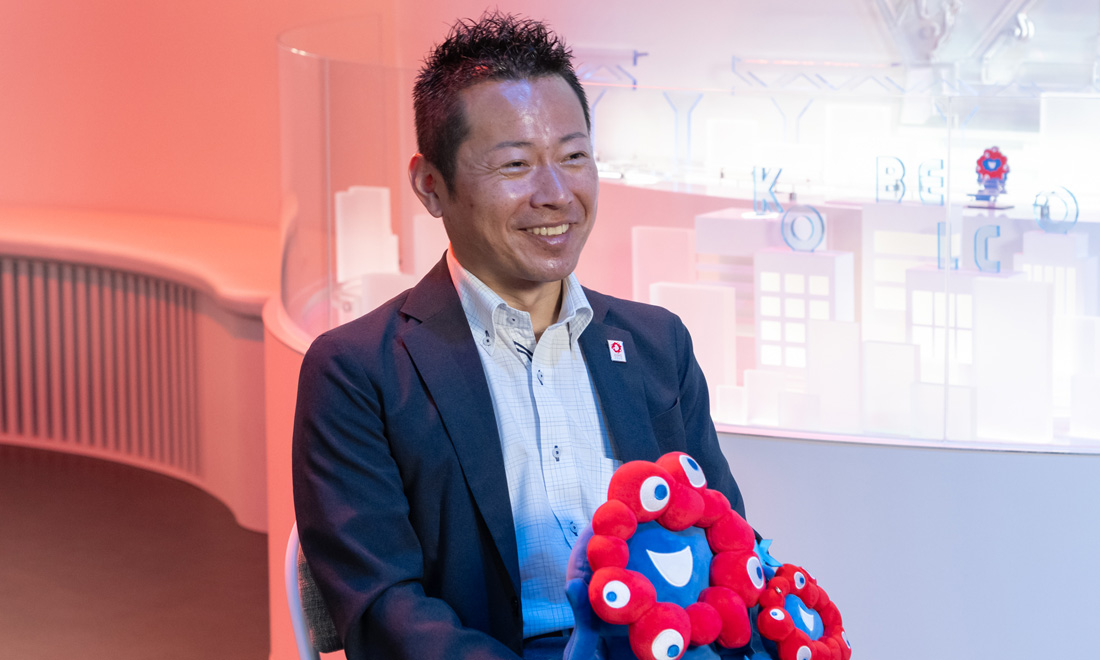
"When I first heard about it, I couldn't imagine at all that I would be in charge of this project." So says Yohei Ikeda of the "KOBELCO Group," which supports the foundation of society across a wide range of fields including materials, machinery, and electric power.
The KOBELCO Group is developing an experiential exhibition that conveys the fun and possibilities of "monozukuri" (manufacturing) with the theme of "The Power to Create Future Prosperity" at the "City of the Future" pavilion of the 2025 Japan International Exposition (Osaka-Kansai Expo). NOMURA MEDIAS was responsible for the planning, design, construction, production, and operation of this exhibition. It was a major project that progressed hand-in-hand for over two years from the initial concept.
"At the time we received the offer, it had been about a year since three group companies merged to form NOMURA MEDIAS. The Expo was a big challenge for us too, but it wasn't just our desire to do it; the fact that we had the capability to do it by combining the strengths of the three companies also became a trigger," recalls Yui Yoshida, Account Producer, looking back on her encounter with the Expo.
In this project, the team worked together as one, going beyond spatial design—such as how to present the exhibition as a whole—to tackle fundamental questions: "How can we convey what KOBELCO holds dear to the visitors? What kind of future should we present?"
Mr. Ikeda says, "KOBELCO is a company that values sincerity over flashiness. We have seriously and steadily supported society through technology. Just conveying that attitude as it is might not reach children. However, by devising creative expressions, I thought we could ignite a feeling of 'I want to make something myself.'"
Pride in technology and responsibility for the future. NOMURA MEDIAS focused on KOBELCO's aspirations and translated them into the exhibition design. Mr. Ikeda also said that he was helped many times by this attitude. "There were times when I struggled midway. But the fact that we could share the questions of 'What is KOBELCO's identity?' and 'How can we communicate with the future?' was encouraging."
Thus began the challenge of the KOBELCO Group and NOMURA MEDIAS. The communication towards the future took shape on the grand stage of the Expo.
The accumulation of uncompromising trial and error
The "seeds" of free ideas
Blossoming into a moving exhibition
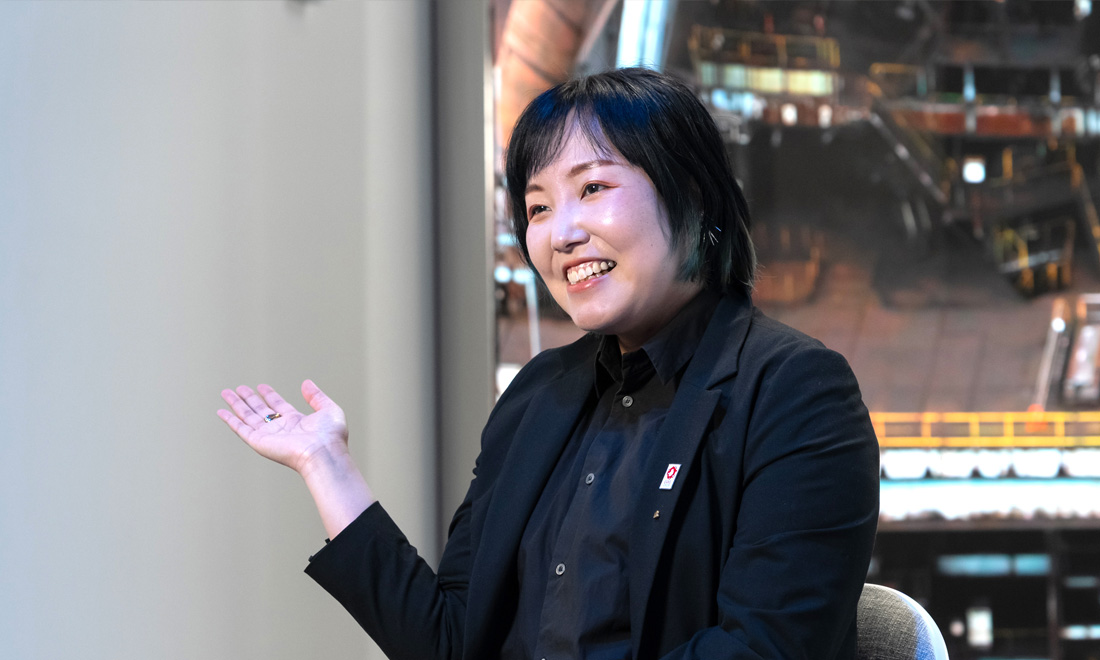
The project officially kicked off in the spring of 2023. Within a limited exhibition space, how should KOBELCO's diverse businesses and technologies that support society be showcased? What kind of experience should be provided to visitors? Days of searching for those answers began.
Young and mid-level employees gathered from various business divisions within the KOBELCO group as an idea team, freely exchanging opinions with NOMURA MEDIAS members from the start. From there, regular meetings were held once a month for about two years. From the initial conception stage, they shared the determination to 'not let it end as a mere industrial exhibition,' and members from both sides continued to face each other seriously.
Mr. Ikeda laughs, saying, "At first, rather than whether it was feasible, we asked them to freely come up with ideas. Many interesting opinions came out, which still leave an impression on me." Asuka Takami, who was in charge of spatial design, looks back: "Contrary to the image of KOBELCO being sincere about technology, they were flexible in their exhibition expressions, and more generous ideas than expected flew around. They actively reacted with 'That's interesting!' even to proposals where we hesitated, wondering 'Is it okay to go this far?' That felt very fresh."
Nodding in agreement is Satoshi Ono, who was responsible for the design and production of the spatial direction. "It was precisely because of our dialogue with KOBELCO that we ultimately arrived at a structure where the visitor's journey unfolds like a single story. To our proposals, they would throw back opinions asking, 'Isn't this what KOBELCO-ness is all about?' That repetition became the soil that deepened our ideas."
In the process of incorporating product elements into the exhibit, Takami struggled with balancing the feasibility of the design and the visitor experience. "KOBELCO's products rarely get seen by us in daily life," she says. "Yet, they are all crucial things that support social infrastructure. How do we convey that invisibility? Through repeated prototyping, we settled on a structure that sparks interest from any angle."
Proposals were brought in at each regular meeting, and new ideas were developed through feedback. While repeating revisions, a common language gradually developed between the two parties. The accumulation of uncompromising trial and error. Through that process, the team's bonds and passion naturally grew stronger, and such a relationship accumulated in the exhibition space.
-
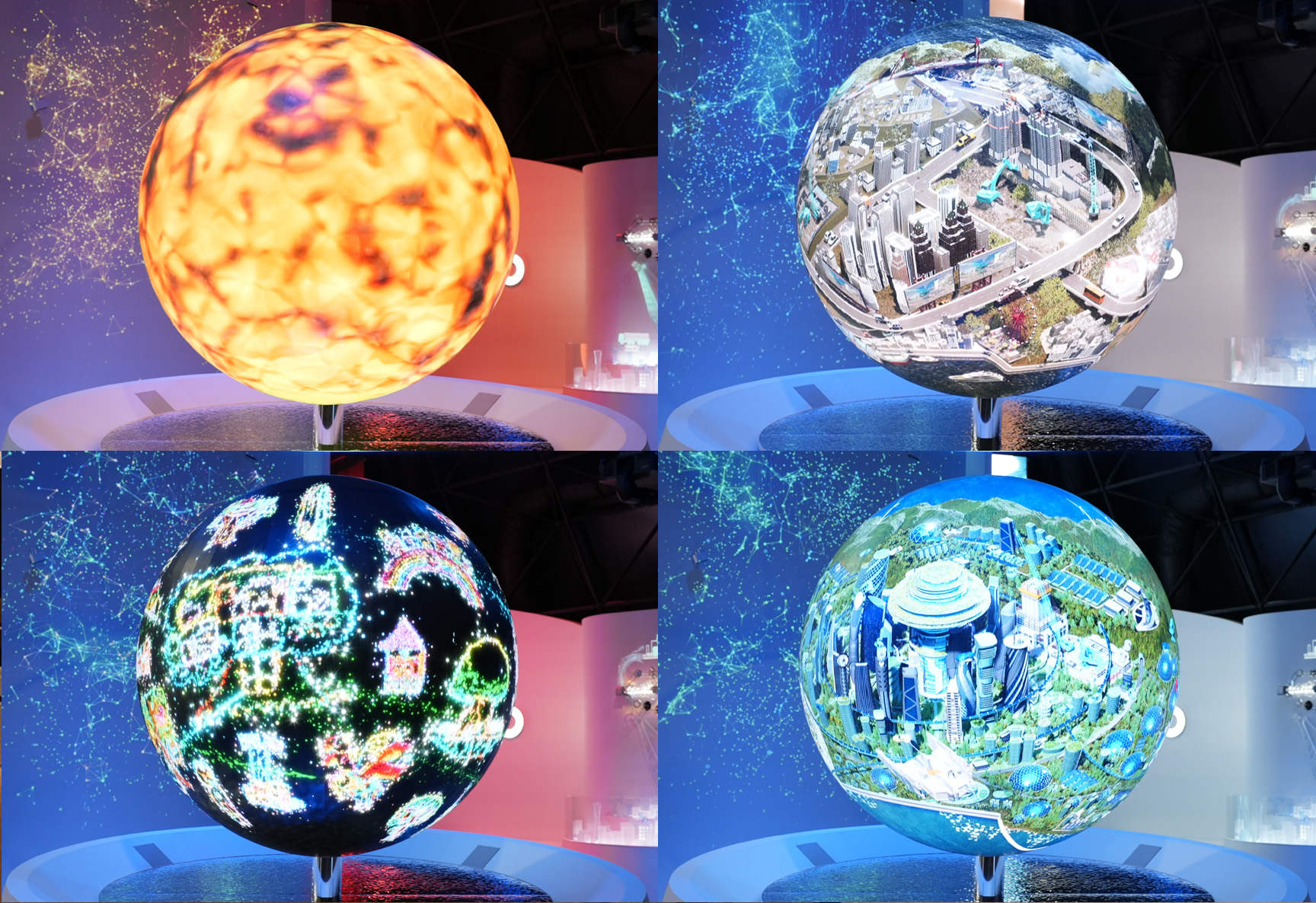
Starting from materials to the current city, and then to the ideal city of the future. A spherical vision that gradually changes its expression -
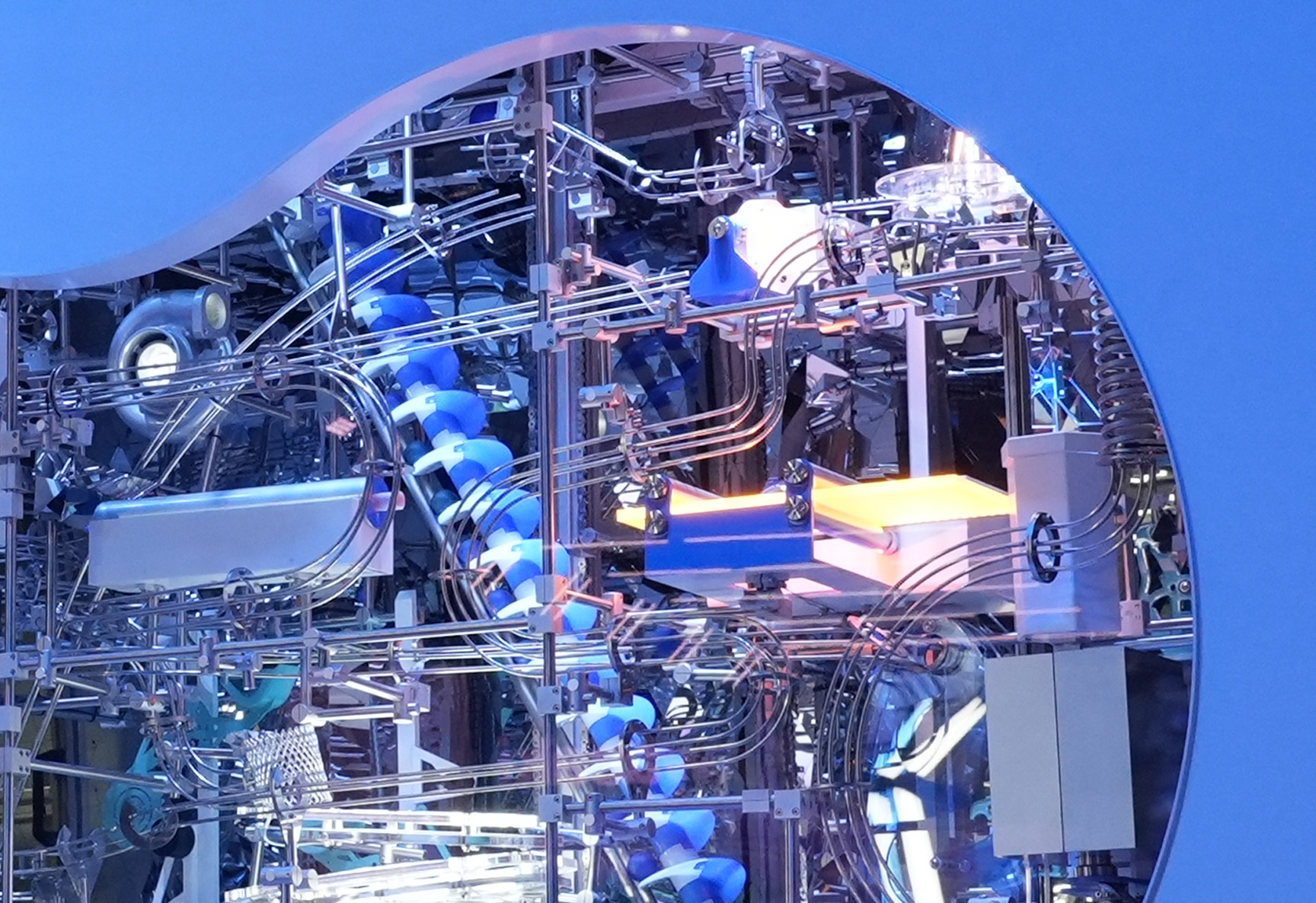
Inside the ball coaster, where KOBELCO's technology is expressed everywhere -
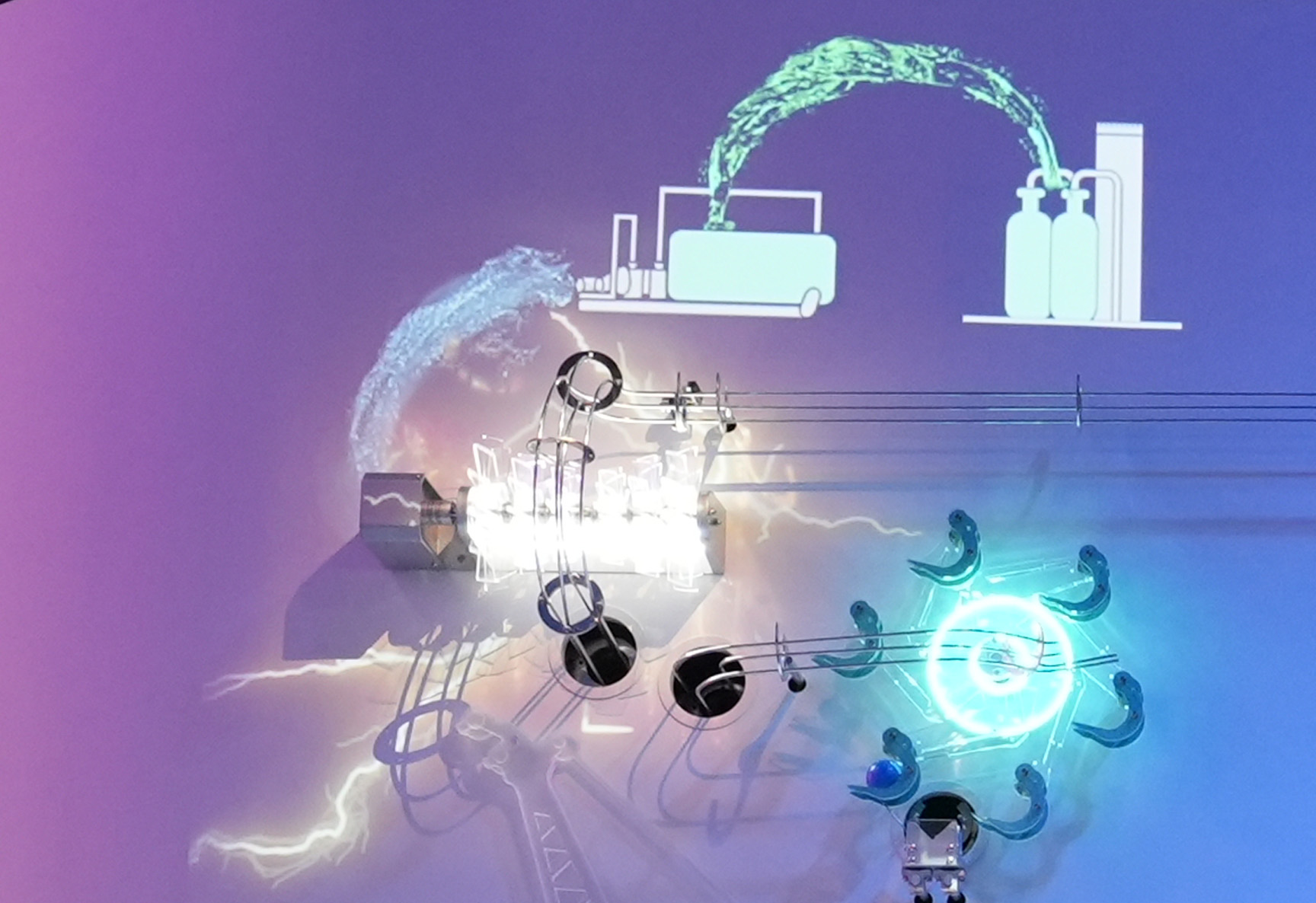
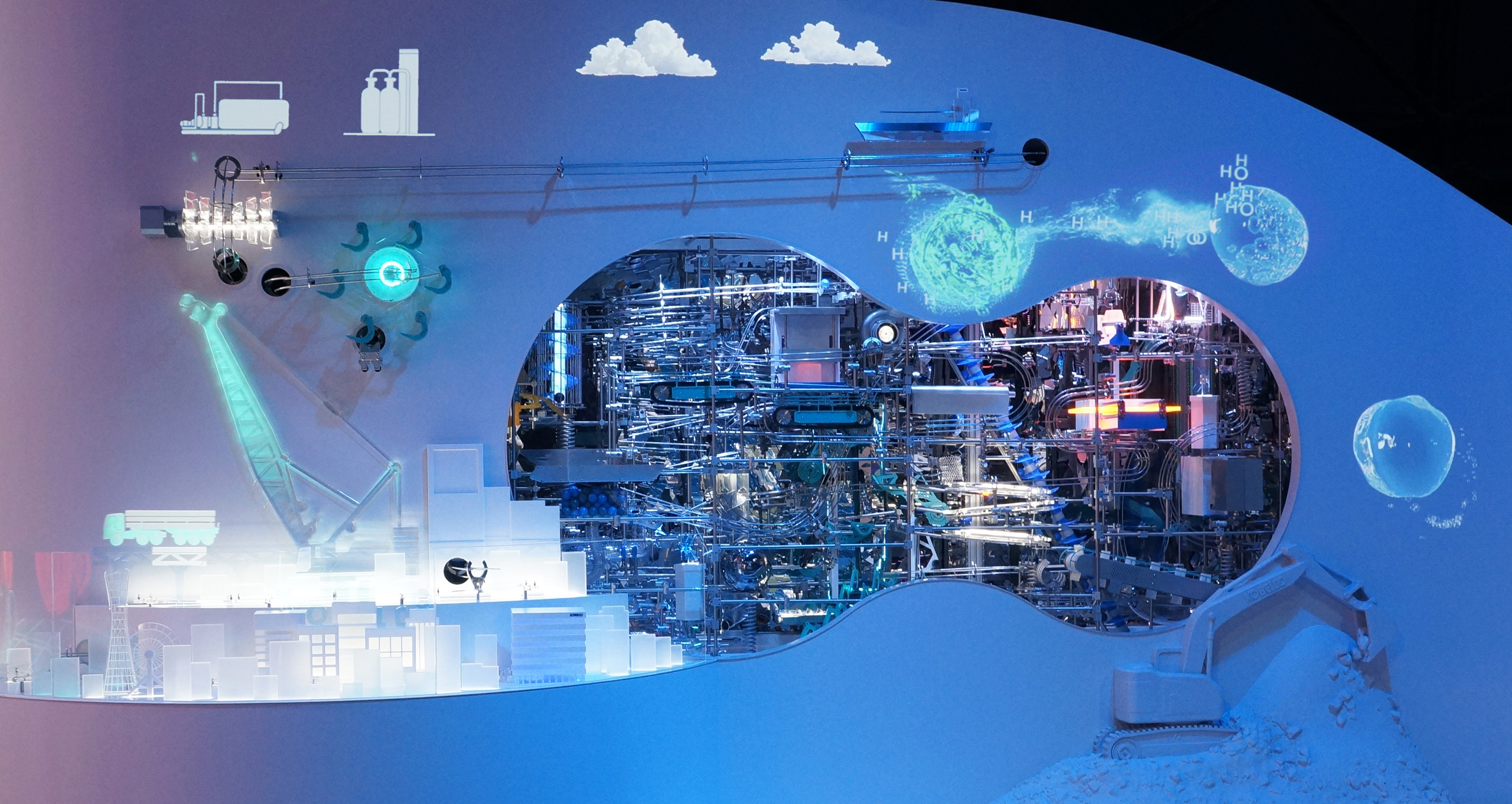
Expressing the flow of energy through a combination of realistic ball movement and visuals -
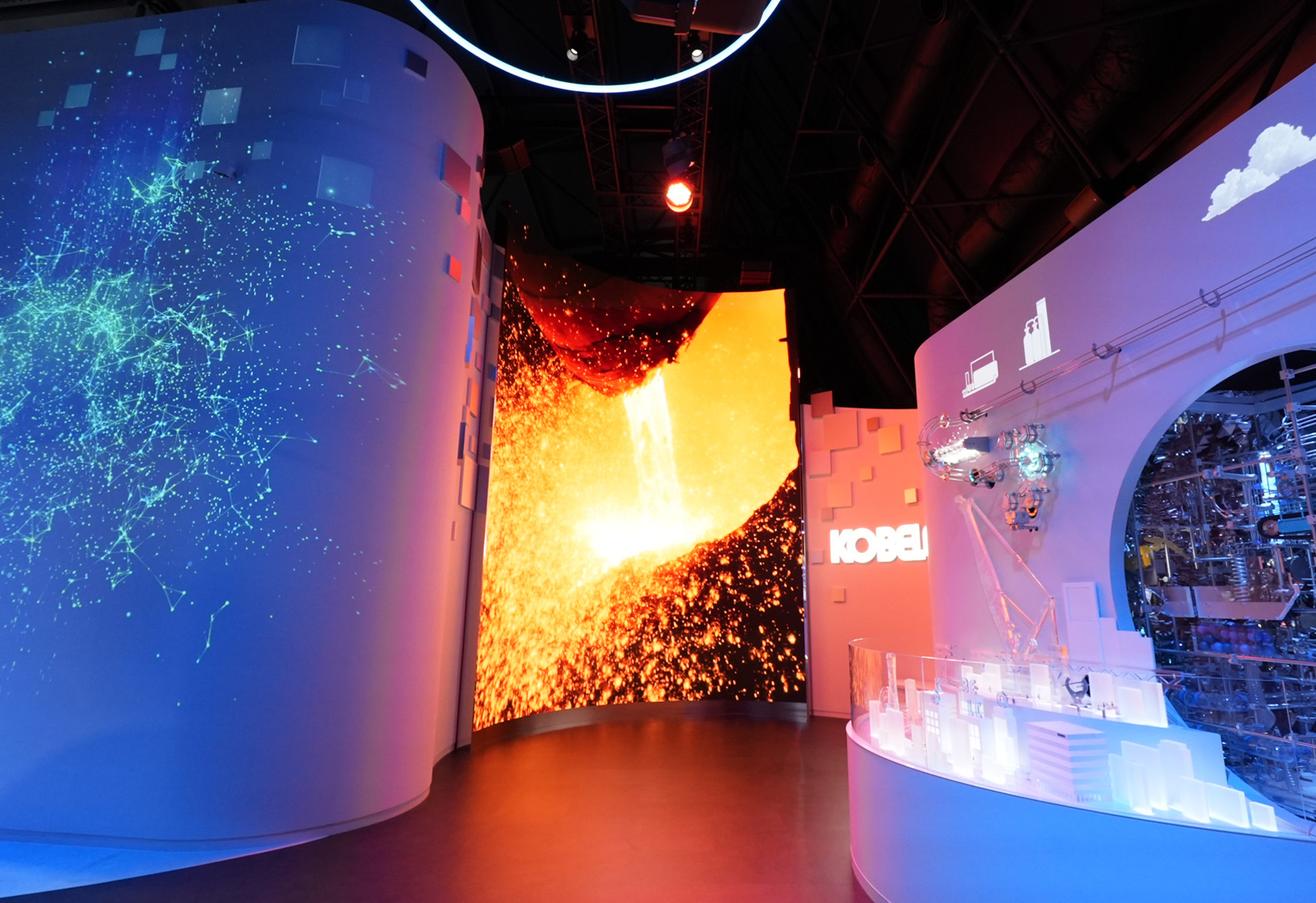
To represent the connection of businesses, the exhibition space was also designed with a flowing traffic line
A spherical vision looking up at the future.
Technology and wishes communicated through space
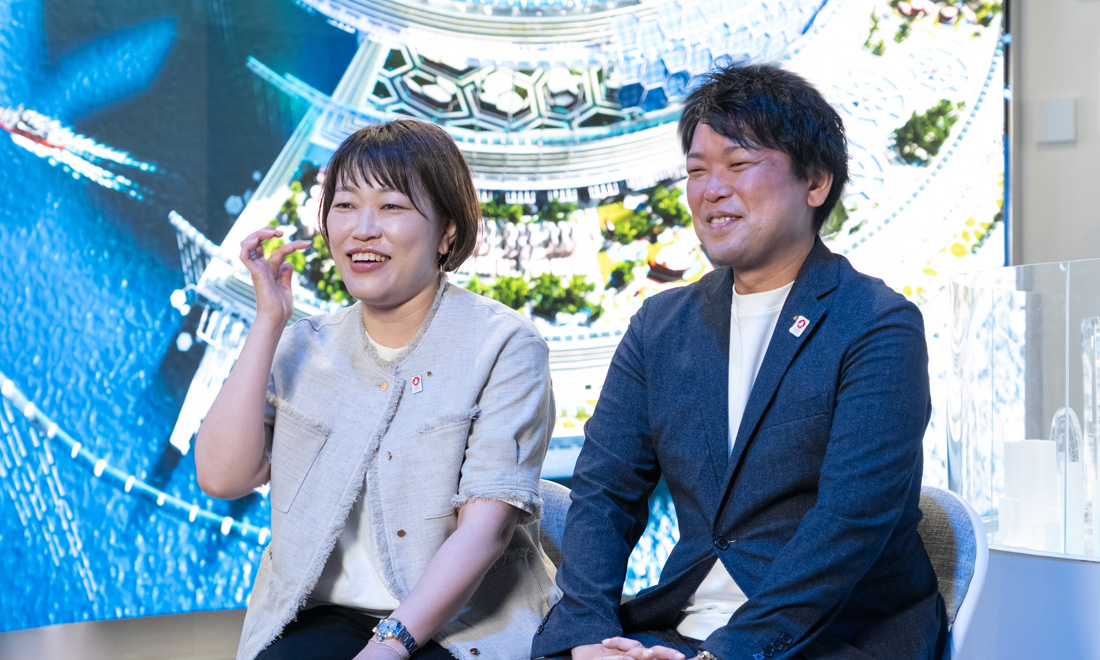
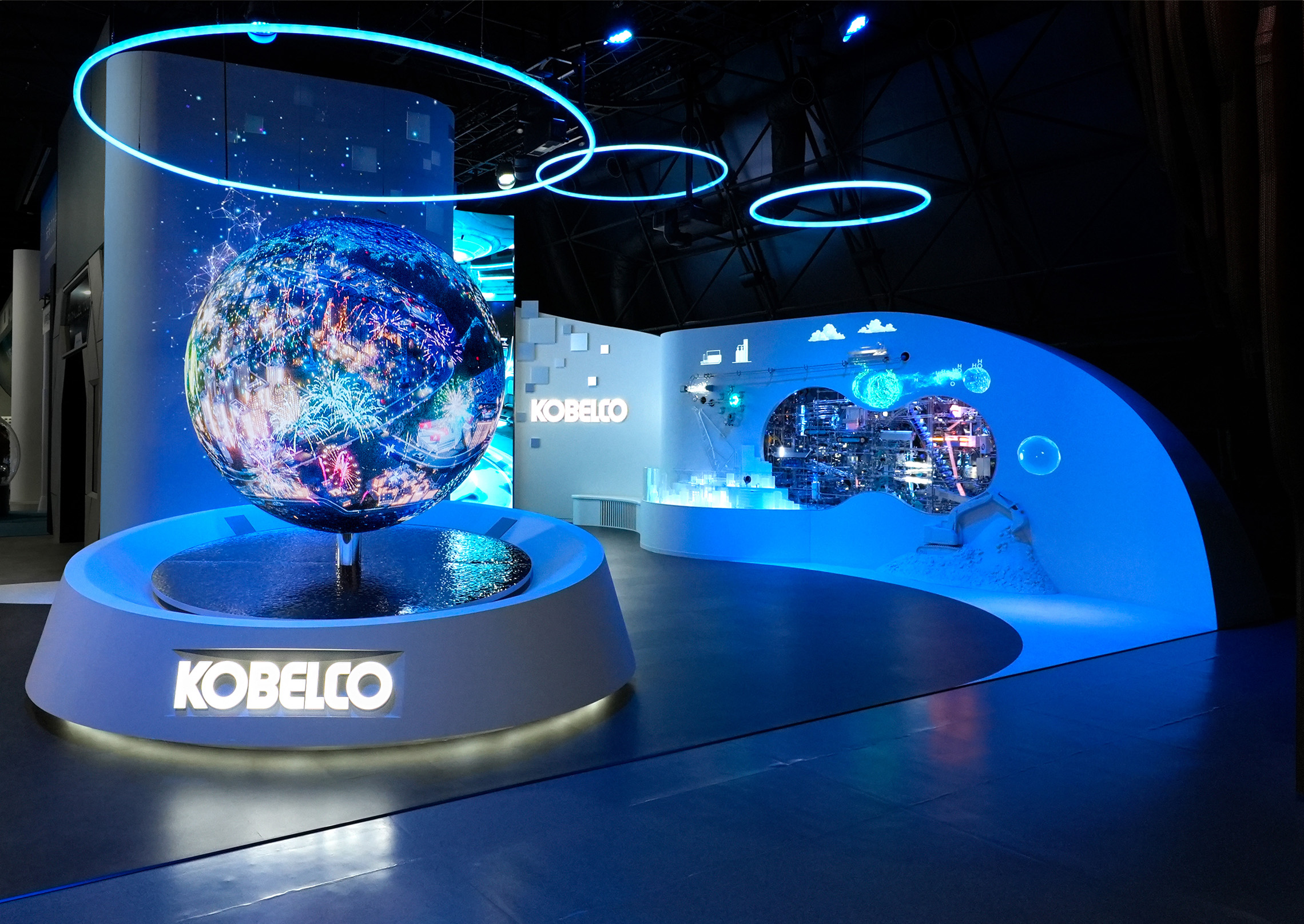
Installed at the entrance of the place, named the 'Symbol Zone', is a spherical LED vision approximately 2 meters in diameter. As a symbol of KOBELCO's exhibition space, it broadcasts messages in all directions, naturally drawing the gaze of visiting people. The imagery projected on the sphere gradually changes, shifting from the current state of the town to drawings of a dream-filled 'town I want to live in' drawn by children, and then to an ideal town of the future. This striking symbol was designed to visualize KOBELCO's gaze toward the future.
For NOMURA MEDIAS, which handled the overall spatial direction, the spatial composition, including this spherical vision, was a series of trial and error. "How can we appeal to children's sensibilities with KOBELCO's technology and values?" said Takami. "To express KOBELCO's unique 'combinations' and 'connections' in its business, we decided to make the layout within the space a 'looping path' where visitors could go around and experience the businesses, rather than exhibiting them individually. We created many models and held numerous discussions internally and externally to bring that to fruition."
Supporting that process from the sidelines were account producers Yuri Yoshida and Hikaru Furuichi. As sales representatives involved since the early stages of planning, the two played the role of materializing the direction of the exhibition on-site.
Furuichi reflects, "In meetings with KOBELCO's idea team, a considerable amount of specialized knowledge regarding materials and machinery was necessary. That is precisely why we repeatedly coordinated with our internal designers and directors on the delicate balance of how much to abstract the message for visitors to enjoy, and conversely, what areas to delve deeper into." He continues, "Whether it's steelmaking or the technology supporting society, KOBELCO's business is on a surprisingly large scale. We wanted to convey that. However, the people actually coming to the Expo are children and families. Therefore, rather than just showing the technology as it is, we needed to translate it into a design that communicates through experience. I think our role was to stand between KOBELCO, the design and planning team, and the visitors, adjusting the intentions and temperature of the experience."
Starting with the production of the spherical vision, mechanisms that allow visitors to experience the circulation of products and energy are embedded throughout the space, allowing visitors to perceive them through physical experience rather than mere explanation or exhibition. Breathing within it was the entire team's wish to "deliver the fun of manufacturing to children."
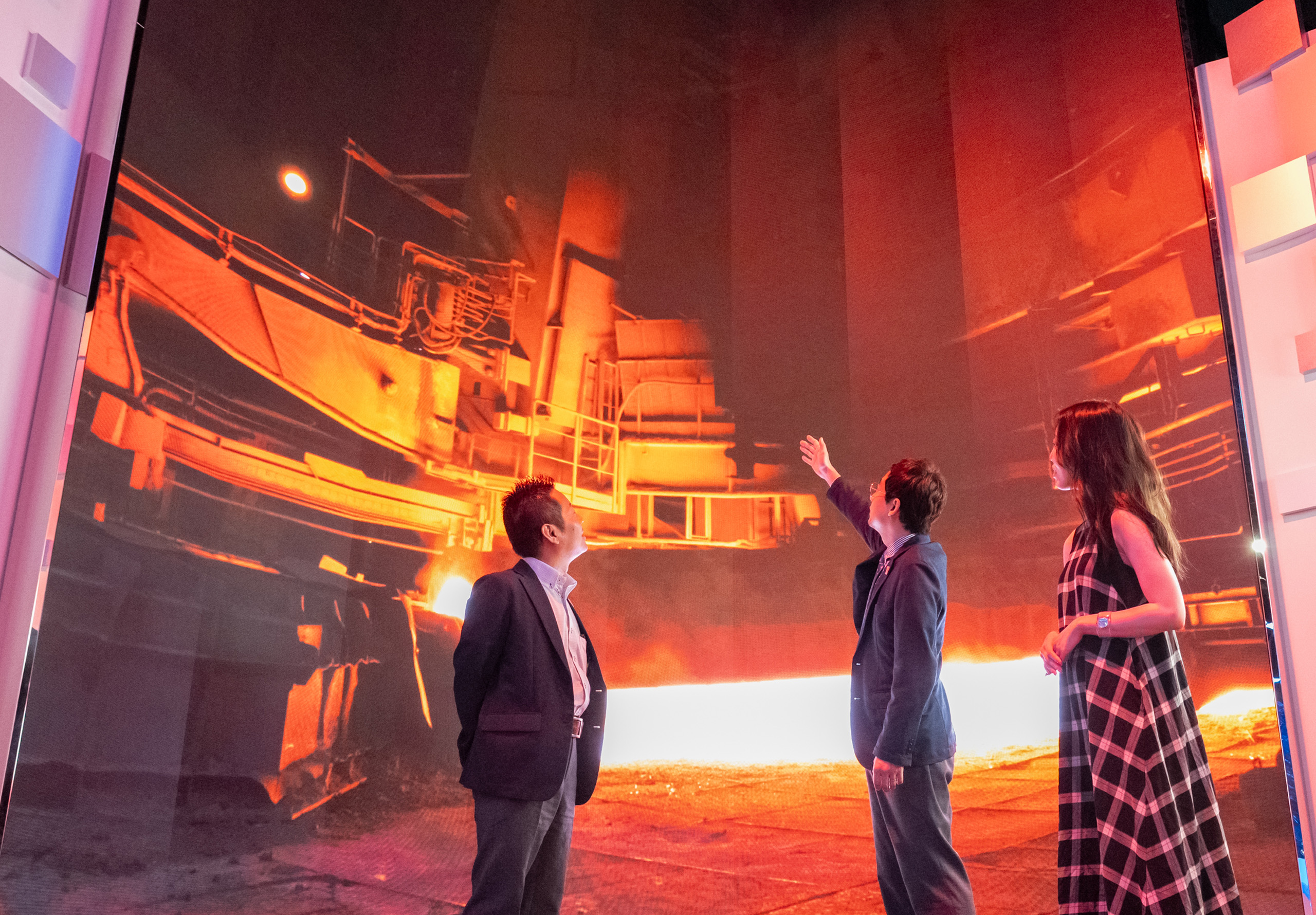
The seamless flow experienced by visitors in the exhibition space was born from the accumulation of dialogue and ingenuity among the project members.
The spherical vision displayed at the entrance of the space welcomes visitors as a symbol of a rich future. Beyond it is the 'Real Zone,' an installation combining a ball coaster where real balls roll with digital visuals projected on the wall. It fantastically depicts how KOBELCO's core strengths—'Materials,' 'Machinery,' and 'Electric Power'—intersect to support modern urban development. Inside the coaster, motifs related to KOBELCO's businesses, such as MIDREX® plants, converters, compressors, and welding, are scattered about. The movement of the balls expresses the continuous flow from manufacturing to urban development. There are nine different routes for the balls in total, and children were captivated by the coaster with its various gimmicks.
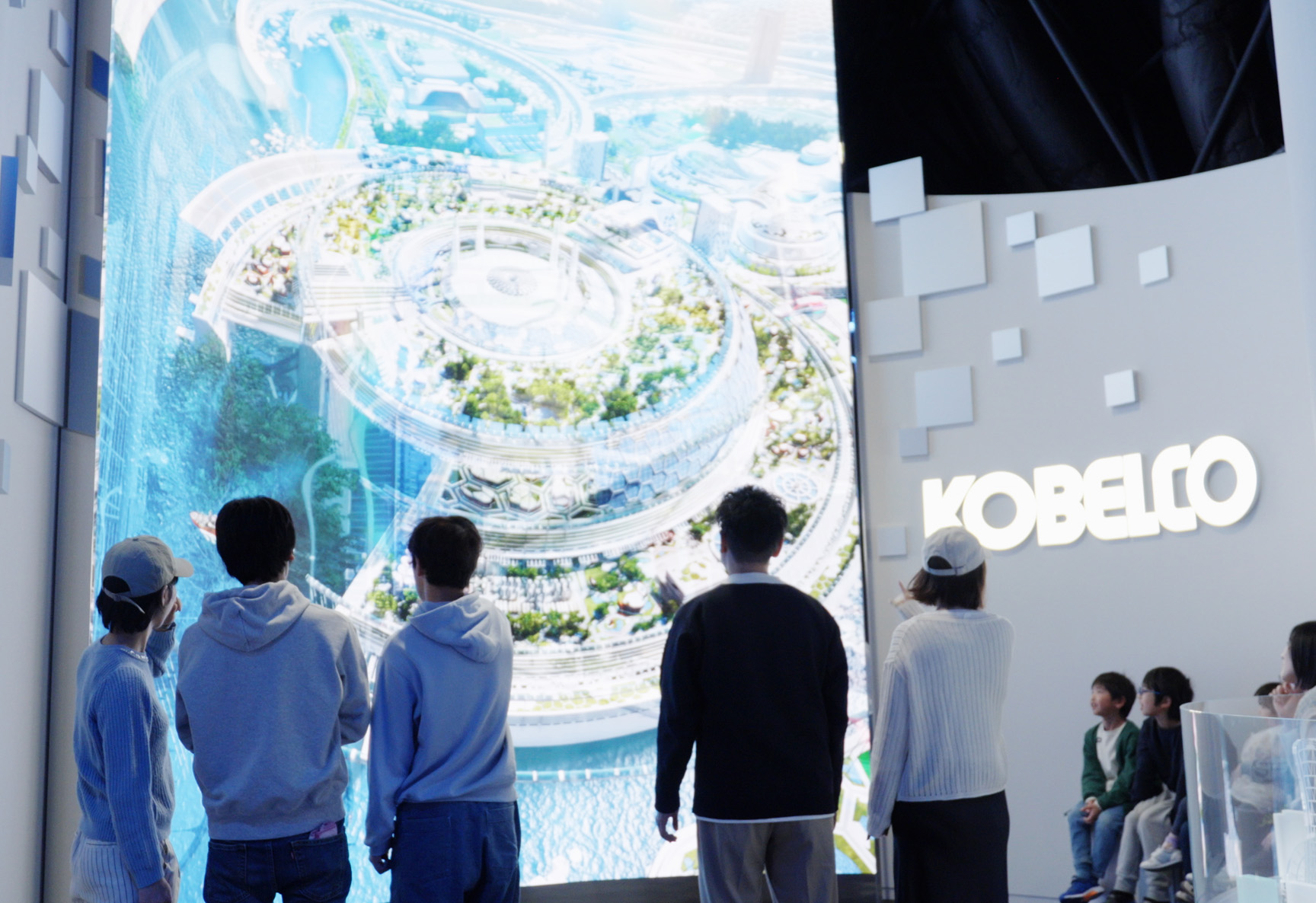
Furthermore, at the very back of the exhibition space, a massive 5.25-meter-high LED vision was installed as the "Dynamic Zone." From KOBELCO's technologies supporting current society to its challenges for the future, everything was expressed with powerful imagery, leaving a strong impression on visitors.
"It was difficult to clear safety issues, but by actually having them look at drone footage of overseas steel mills, repeating negotiations many times, we were able to make it a reality and shoot powerful footage," said Ono, speaking about the steel mill drone footage they put particular effort into for the 'present' part of the video.
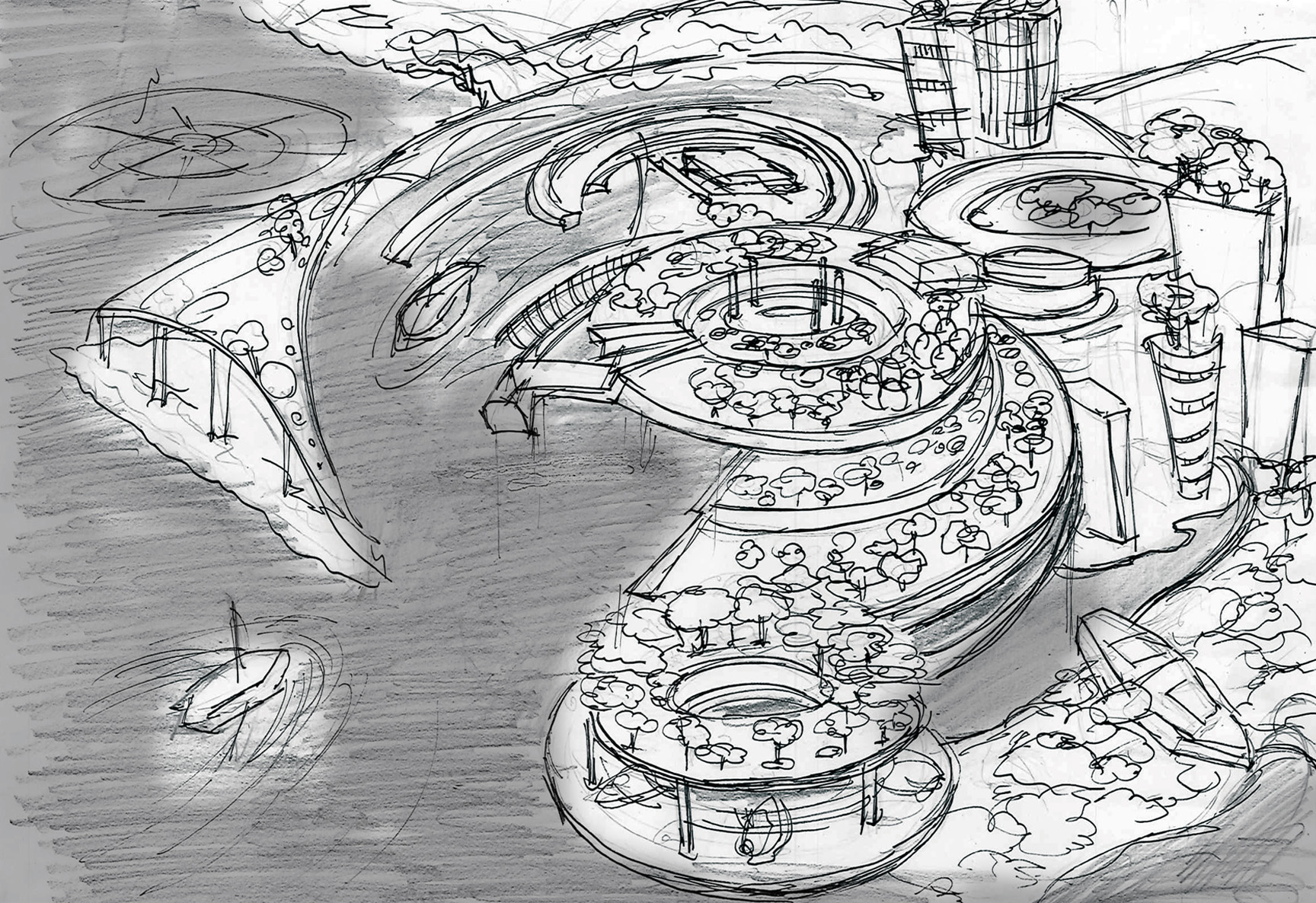
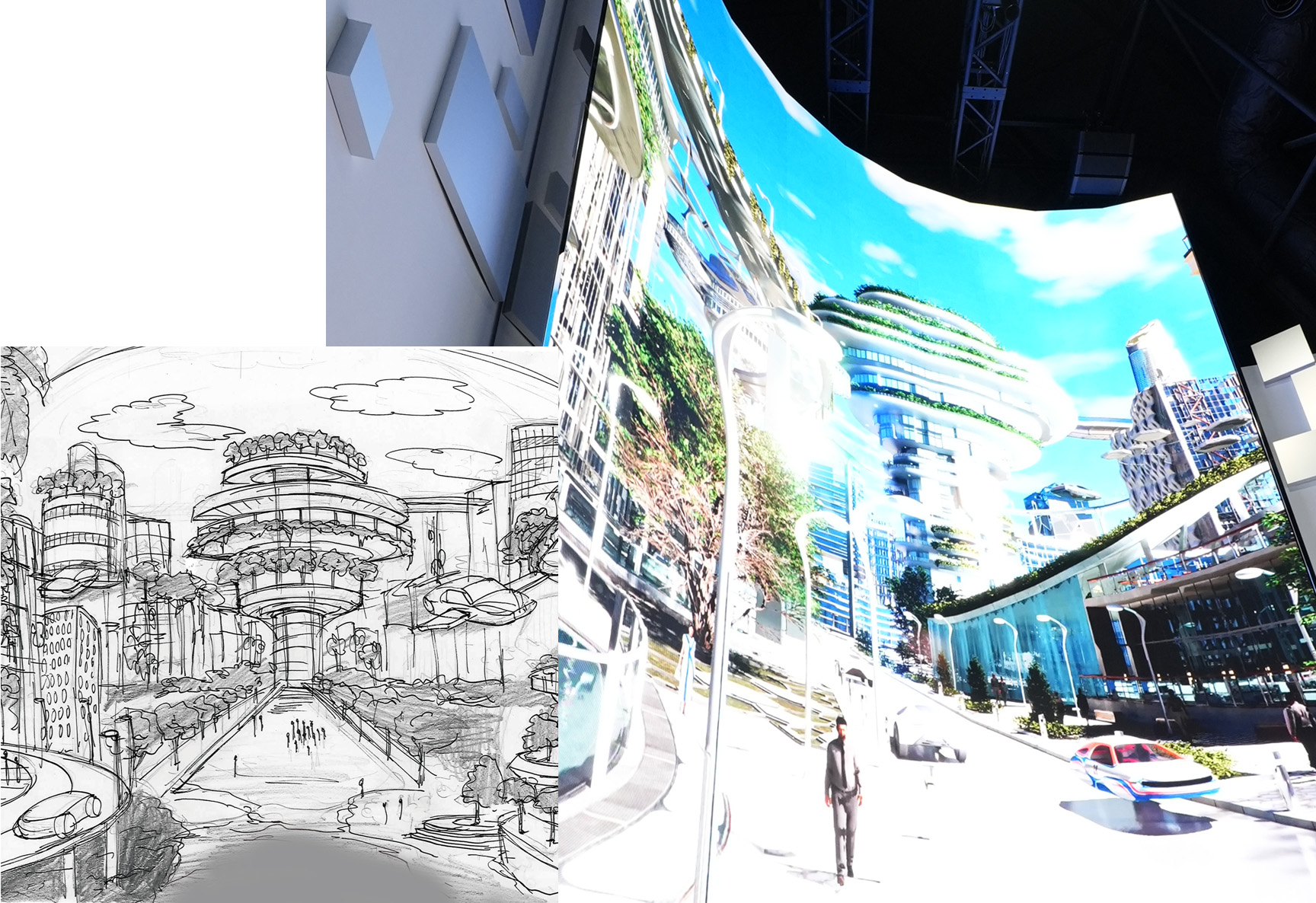
Moe Nishihara, who was in charge of video design, says: 'Since the 'future' part had to be created from scratch, I first asked everyone about 'the ideal city of the future.' From there, we built an image of the future and had each business division pitch what we could do in response to it. I struggled to ground the 'future'—which tends to lean toward fantasy—realistically as an extension of KOBELCO's technology so people could truly feel it.' By drawing numerous sketches and going through repeated trial and error, a future video unique to KOBELCO was successfully created.
Everywhere in the KOBELCO PLACE exhibits, clever touches are employed to naturally draw visitors in through visual presentation and intuitive operation. Rather than providing one-way explanations, each exhibit is designed so that visitors can touch, feel, and internalize the content themselves. There, the team's determination to convey the joy of manufacturing and hopes for the future breathes quietly yet surely.
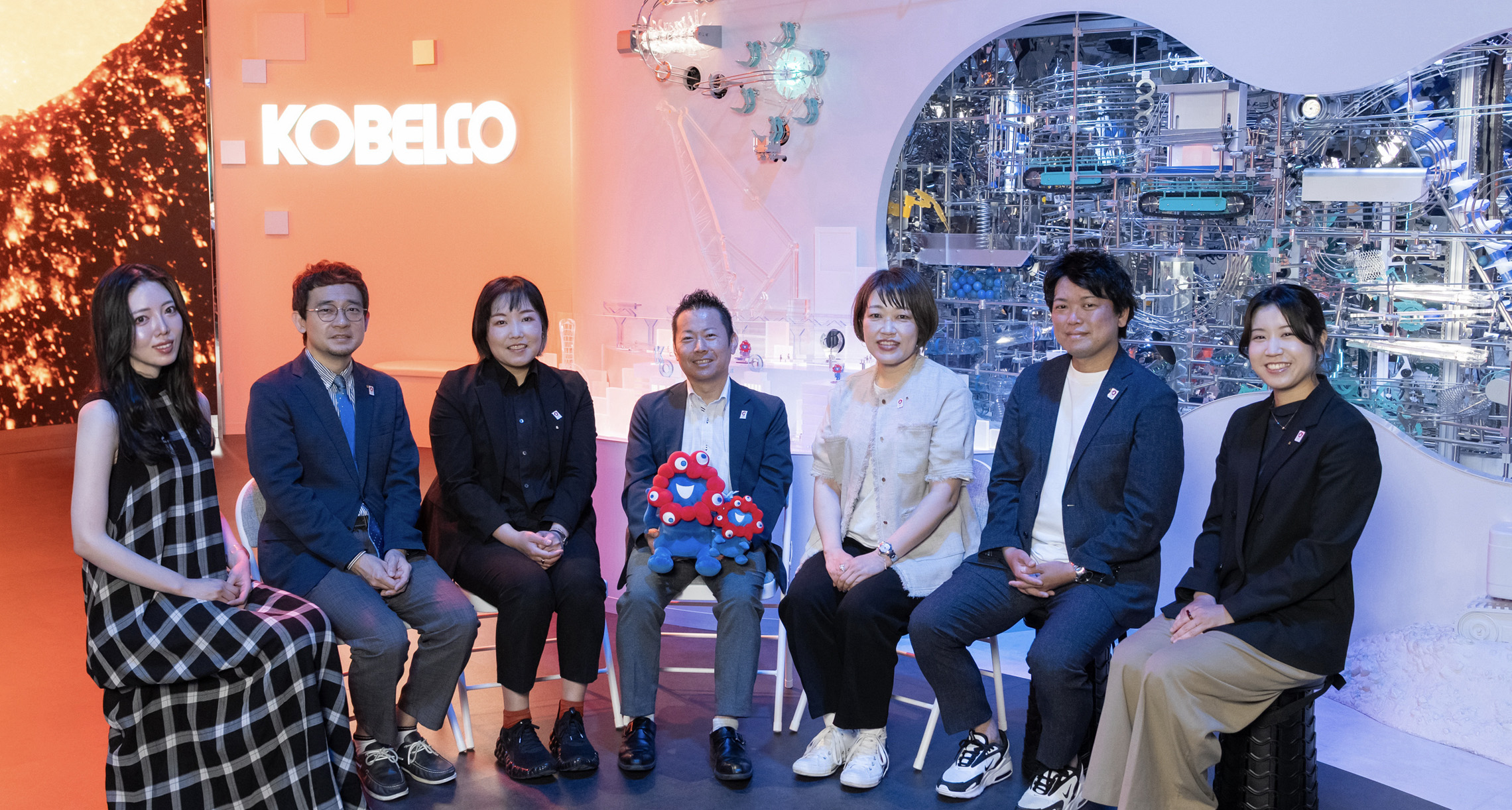
The completion of the exhibition space is not the final destination.
The trajectory of the journey walked together as a team continues toward the future.
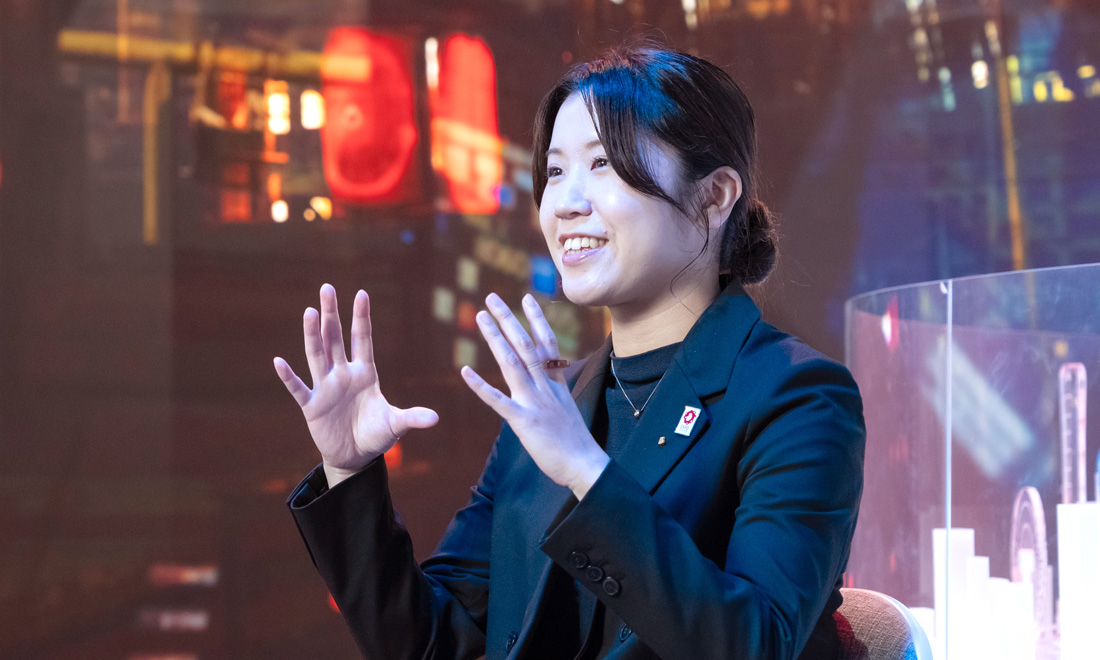
Transcending the framework of a corporate introduction, KOBELCO's future urban co-sponsor place culminated as an experiential space where visitors could receive "future affluence," designed so that its technology and thinking are naturally communicated through the five senses.
After the opening of the Expo, Yuma Nakakita, an account producer, supported this space from an operational standpoint. Having observed visitors' reactions on-site every day, Nakakita shared a sense of accomplishment, saying, "It became an exhibition where people not only marveled at the technology, but also wanted to share their impressions with their families and friends after experiencing it."
Yoshida also looks back, saying, "At first, I had some anxieties, but after the opening, many people stopped to look at the exhibition. Especially on the first day, when I saw the children engrossed and enjoying the ball coaster, KOBELCO and I were overjoyed, saying, 'We could cry.' At that moment, I truly felt that we had been aiming for the same goal. The theme and target of this exhibition was 'the future.' It was deeply moving that we were able to reach the children who may one day become employees of the KOBELCO Group." Mr. Ikeda also smiled and said, "We were able to share with the people at NOMURA MEDIAS the desire to create a 'place where visitors can feel' rather than just transmit information. Although we are from different companies, I believe we truly created something great as 'one team.'"
Yoshida says, "A new future begins with taking a step forward. And the Expo was a great opportunity to challenge ourselves with that step. These two years of continuing to challenge ourselves to build something never seen before from scratch together with KOBELCO have been a truly invaluable experience. We now feel the importance of 'taking on challenges' with a different weight than we did two years ago. It is a sensation we want to cherish precisely because it has become harder to take on challenges in the modern day."
It took countless adjustments and ingenuity to bring the axis running through the diverse businesses of materials, machinery, and electricity together into a single cohesive experience. However, as a result, the completed space powerfully etched the outline of the future envisioned by KOBELCO.
This was a project that carefully explored the question of what it means to convey the essence of something, in the form of an exhibition. This exhibition space, assembled by many hands, tells the story of how the KOBELCO Group is facing the future through manufacturing. Towards the theme of "The Power to Create Future Prosperity," the questions were: "What should change, and what should not change? What can we do to change, and what can we do to keep things the same?" As a partner who walked alongside the project, NOMURA MEDIAS fully fulfilled its role in shaping and delivering those aspirations. And perhaps, it was a creative journey that went beyond mere business.
The spherical vision and ball coasters exhibited this time are scheduled to be relocated to various locations in Kobe City after the closing of the Expo. The completion of the exhibition space is neither the end of the project for KOBELCO nor for NOMURA MEDIAS. It will be passed on to the future as a trace of an experience that will long remain in the hearts of visitors.
Inside the "Future City" pavilion, beyond the impressive robot head, lies the KOBELCO Place, created by NOMURA MEDIAS.